
In Minnesota, a marriage amendment is being announced right now which would put the issue before the people of the North Star State in 2012. It will shortly be introduced officially in the MN State Senate.
Here is more from the press release just published:
“The proposed constitutional amendment asks voters to define marriage as solely between one man and one woman in Minnesota. This issue constantly comes up during legislative sessions and it’s time for the people to decide. Allowing a small number of politicians, or activist judges in St. Paul to decide the definition of marriage would not be acceptable. We propose an early passage in the legislature this year, followed by a year discussion in our communities statewide in order to be prepared to vote in next year’s General Election,” said Senator Limmer.
“It’s time to empower Minnesotans with a choice on an issue that has been brought up numerous times in the legislature. This constitutional amendment puts the definition of marriage in the hands of the voter. There are a variety of perspectives on this issue, we are simply trying to give people the chance to express their opinion at the polls,” added Senator Gazelka.
“This amendment has been put to the voters in numerous states. On issues like this, I believe that it is best to let the people decide rather than a small group of legislators in St. Paul. By putting this definition of marriage on the ballot, we can ensure that this decision will accurately reflect the values that Minnesotans believe in,” said Senator Hann.
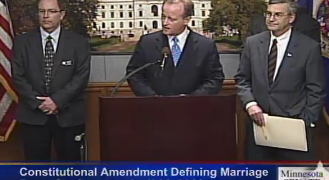
Stay tuned for more updates on this exciting development!


19 Comments
This is HUGE, particularly considering the fact that 2011 was the year pro-SSM groups and legislators planned to impose SSM on the people of MN without a vote.
Elections have consequences, and here's your proof.
The important thing is that Minnesotans will finally get to vote on the issue. Are people really as pro-SSM as the advocates claim? Guess we'll find out!
The odds look good that both MN and NC will have marriage amendments in 2012. Both have just seen the GOP take control of both chambers of their legislature for the first time in a century (NC) or several decades (MN). Other states, such as IN and PA, require amendments be passed in successive sessions of their legislatures, but MN and NC require only one approval by the legislature.
As for the result at the ballot, the vote for marriage has been about 12% higher than the vote for the GOP candidate that year. 44% of Minnesotans voted for McCain in 2008, and I doubt that fewer would vote for the GOP candidate in 2012, because 2008 saw large Democratic turnout. This is the most basic statistical model; I'll look at some others when I have a chance to get firmer numbers on what a MN marriage vote might look like.
The majority leaders of both the MN House and the MN Senate are Catholic, so I suspect that they care about the marriage issue and will be willing to let these measures reach the floor.
Does anyone know about the potential for passage? Why did it take this long and can they derail it? Also - why did it not occur earlier and is this a state with mutiple hurdles like Indiana
Finally, voters will be able to put this to rest, and keep things as God meant them to be.
This is very important and is no doubt causing liberals to squirm because it throws doubt on the claims that gay marriage is now supported by a majority.
Putting the rights of a minority up for a vote by the people. Would we still have segregation in this country if attempts to end were handled thru popular vote?
Carlos, if the politicians were opposed, and the people were solidly in favor of redefining marriage, you'd be arguing the opposite.
Carlos -
The word "homosexual" did not even exist in this country until the late 19th century. Up to that point, homosexuality was treated as what it is: a disorder, environmentally acquired, that has no redeeming social value.
Unlike other classes of people, homosexuality is a false "class" of people; it is not immutable, it is not genetically acquired. It can be learned and it can be controlled. We should be conducting research to identify its exact cause so that we can prevent same-sex attractions in children and help existing "homosexuals" who want to live normal lives to be cured of this disorder.
As a Minnesotan myself I am very encouraged by this development. Please keep us, and especially Archbishop John Nienstedt in your prayers. I'm sure there will be a barrage of Anti-Catholic attacks as this amendment is debated, and Archbishop Nienstedt has already been brutally attacked on this topic already.
Carlos- do you know what you are talking about? Most states did not have segregation or ended it through democratic means. Indeed, most states did not have segregated schools in 1954 when Brown came down, and most states did not have anti-miscegenation laws in 1967 when Loving came down. Women's suffrage, of course, came about through the extra-democratic constitutional amendment mechanism. In a pluralistic society, people disagree about what rights are, and legislators change rights all the time. These sorts of novelties, such as same-sex marriage, are decided through democratic means, as they have historically been. If you want to change the definition, then go to the people.
Wow. I thought Minnesota was a pretty good state to live in, and now some people think it's okay to write discrimination into our state constitution? No. It is definitely not okay!
MIke P. is correct that most states didn't have anti-miscegenation laws in 1967; only 17 states retained such laws. However, the American people were overwhelmingly opposed: according to Gallup, in 1968, 75% opposed inter-racial marriages, with only 17% in favor of them. It wasn't until 1991 that a majority of Americans approved of these marriages. Does that mean anyone wanting to marry outside their race should just have waited until 1991? Are inter-racial marriages prior to 1991 less valid because only "activist" judges approved of them?
Good.
While the Minnesota Supreme Court ruled that banning same-sex "marriage" is constitutional (see Baker v. Nelson, 191 N.W.2d 185, (Minn. Sup. Ct.) (1971) summarily aff'd 409 U.S. 810 (1972), it did not rule on whether the legislature could expand the definition of marriage. A constitutional amendment would enshrine the definition of marriage as a "union for life of one man and one woman in the holy estate of matrimony".
A minority of states representing just 10% of the American population could have blocked the Nineteenth Amendment.
Their opposition to interracial marriage did not necessarily translate to support for anti-miscegenation laws.
This is great for the fine people of Minnesota. The homosexual activist were trying to impose SSM on the people without their consent. But now there will be a vote.
To Fitz: The reason why it took so long was simple. The liberal ( not letting the people vote) controlled the legislature. As Barb said in post #1, elections have consequences. In 2010 the Legislature switched control. The people voted in senators who favored a vote. As long as this group is in charge it will not get derailed. That was the only hurdle.
Finally to the other Michael B. welcome aboard. I am happy that you get to vote. By allowing your side to vote your state can avoid the damage that was done by SSM in Massachusetts.
To Bruce and Carlos:
The big difference is that interracial marriages are marriages. They are obeying the one man/ one woman law. Homosexuals have this same right as interracial couples. Homosexuals who obey the law may marry equally as everyone else.
The people want to vote so that we may confirm what the institution of marriage is. One man and One woman. This is what they are voting on, not banning any group of marrying. The people are saying you have the right to marriage but you do not have the right to change the institution.
In post # 7 Carlos uses that same old homosexual lie of rights of a minority being put to a popular vote.
Minorities refers to people and not conduct. Any conduct can be put to a vote. You cannot just behave in a minority way, claim a right to that behavior, and because you do the people cannot decide.
Carlos a question: Drunkards are a minority. If drunks decide that they have a civil right to get drunk , does that mean that their drunk right should not be put to a vote of the people?
Bruce, a high percentage of Americans may have disapproved of interracial marriage, but as Michael Ejercito said, that did not translate into meaningful popular support for banning such marriages. Also, there's an important distinction to make here: disapproving of (or even hating) certain marriages is not the same thing as viewing a particular kind of relationship as simply not being a marriage at all -- which is how most people view "SSM".
Fitz, I'm from Minnesota and I'd be happy to answer your question. An amendment to the Minnesota constitution only needs to pass a simple majority of both Houses of the MN Legislature. Once this happens, the amendment bypasses the Governor's office and is put to the vote of the people in the next General election (2012 in this case).
As for chances at passage, with a GOP majority in both the MN House and Senate and some conservative DFLers (The Democratic party in Minnesota is called the Democratic-Farmer-Labor (DFL) party), I think the amendment will be approved by the legislature. As for adoption by the voters, that takes a yes vote of 50% + 1 of all voters voting in the next general election, and Minnesota is more of a purple than a blue state. I anticipate that the voters in the MPLS-St. Paul suburbs will approve the amendment and that rural and iron-range voters will approve it as well. There are a number of Reagan Dems in Minnesota who are socially conservative and if I had to make a prediction now I'd say the amendment should get at least 51% of the vote.