
NOM BLOG

Heritage Meeting Shows United Front of Marriage Supporters


The Heritage Foundation's Foundry blog (that's our President Brian Brown, of course!):
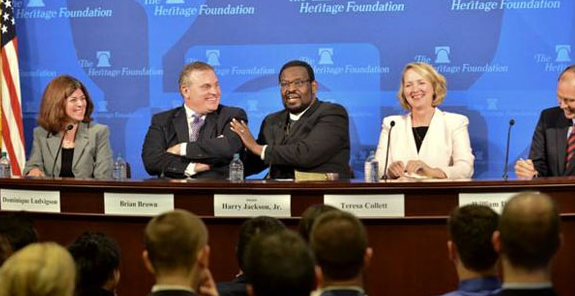
Who gets to make the decision about restructuring and redefining the basic cell of the civil order?” asked University of St. Thomas law professor Teresa Collett on a panel discussing the institution of marriage at The Heritage Foundation Tuesday. Is it the courts? Or under our concept of ordered liberty, should it be the people?

This year, voters in Maryland, Maine, Minnesota, and Washington will see marriage initiatives at the polls in November. Americans in all 50 states will see marriage head to the Supreme Court and be redefined in the Democratic party platform.

4 Comments

  1. Rich
    Posted August 5, 2012 at 7:28 pm | Permalink

    Are you ready for civil marriage growing exponentially come November? Seriously, when it happens, and it will, will you finally get that this country is on the move because it understands that civil marriage is the civil right step to take and your personal religious beliefs have no constitutional foundation of preference?

  2. Publius
    Posted August 6, 2012 at 1:26 am | Permalink

    Civil marriage already exists in all fifty states. Do you mean that the rate of marriage will grow exponentially?

    The Supreme Court held in Loving v Virginia that marriage was “fundamental to our very existence and survival...” This only makes sense if marriage is seen as fundamentally related to procreation. But de-gendered marriage is fundamentally divorced from procreation. The Supreme Court ruled in Baker v Nelson (after the Loving case) against the redefinition of marriage to include same sex couples. The court did not reference any religious texts in reaching this conclusion nor did it need to.

    See also Murphy v. Ramsey.

  3. Little Man
    Posted August 6, 2012 at 5:01 pm | Permalink

    Or, maybe the people should decide whether the people should decide. If the people decide to decide, the judges will back off. The only way judges have decided for same-sex civil marriage is by breaking with precedent, posing the case as a phony case, were about to retire anyway, and intimidated witnesses. If that can be defended in American, we are no longer America. Judging from the economy, we might be a third-world country anyway. The bad economy was crucial for same-sex civil marriage advocates to push their opinions on others (again, through intimidation and illogical arguments regarding friendships and equivalence posed as equality). But it is also the bad economy which limits the patience the people have for threats of using elected official's power against a perfectly law-abiding corporation that does not believe in same-sex marriage, or worse: 'gay' marriage. Yes, logic offends them. Too bad.

  4. Chairm
    Posted August 7, 2012 at 2:46 pm | Permalink

    Little Man, yes, the abuse of judicial review has been a major tactic of the SSM campaign.

    None of the pro-SSM court opinons makes sense even in terms of pro-SSM argumentation that each presents. And these opinion directly contradict each other.

    It goes to show that the SSM idea is a conceptual mess. And yet the SSMers promote the SSM idea as the default alternative to the core meaning of marriage -- which they assail with rules of argumentation and standards of lawmaking that simply destroy their own pro-SSM complaint and their own pro-SSM alternative idea.

    The conflict between the marriage idea and the SSM idea -- the conflict of ideas that SSMers drag before courts -- belongs squarely in civil society. The judiciary is merely one branch of government; and its lack of restraint, on the part of the SSM campaign, is a frontal attack on the principles of good governance whereby lawmaking has its legitimacy.

    They attack the marriage idea, sure, and they use methods that attack self-governance because that its the price that the SSM campaign teaches that society must pay.

    Readers can consider the Massachusetts example -- regarding that state's marriage statutes -- and compare it with the California example -- regarding that state's marriage statutes and, later, that state's marriage amendment.

    In the Goodridge opinion of the MA high court, the pro-SSM side could not find a majority of justices in favor of ruling against the marriage statutes on the basis of sexual orientation discrimination; nor on the basis of sex discrimination. So it made stuff up: it flagrantly rewrote the marriage statutes by recasting the common law definition that had been codified in both the MA constitution and the MA statutes.

    The California high court relied heavily on sexual orientation discrimination even though the marriage statutes entailed no sexual orientation requirement; so the court recast the man-woman criterion of the marriage statute (a criterion explicitly approved by popular plebiscite); the high court relied heavily on sex discrimination and sexual orientation discrimination (contradicting itself) to carve out a judicial objection to civil union which had been legislated immediately after the man-woman criterion had been reaffirmed in the marriage statute.

    The CA high court imposed SSM even though it had already accepted the proposed marriage amendment into the process for amending the state constitution; it then used its error -- of not staying its own decision which conflicted with both the will of the people on the statute and with the clear prospect of reafirmation of that statute in the marriage amendment. Later, when conceding that the marriage amendment was valid law in CA, that same high court blamed its own previous willful error for the SSMs that occured in the interim. The upshot is that the high court attempted to influence the amendment campaign and, when that did not produce an outcome that affirmed its pro-SSM opinon, the court carved out a toehold for its imposition of SSM against the will of the People.

    And, of course, now we see in both MA and CA attempts to use these arbitrary court opinions as the basis for a nation-wide imposition of localized impositions.

    Hey, the SSMers say, SSM is imposed in state law in MA and CA so SSM is authentic marriage! But, wait-a-minute, what makes such an imposition legitimate? The courts? Woa. It is like a dog eating its own tail.

    The abuse of judicial review is a profoundly disturbing problem because it is far too readily resorted to by those who claim to only wish to be included on a legitimate basis of social peace. The means are unjust but so is the claim and the end goal of the SSM campaign.