
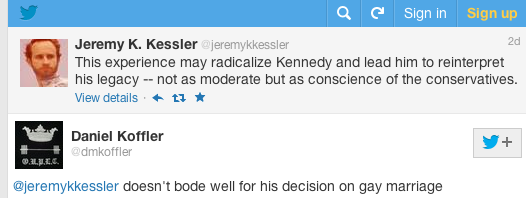
It's still too soon to know -- legal experts are still digesting the Supreme Court's decision upholding the individual insurance mandate in the Affordable Care Act -- but some liberals were already fretting last week that if Justice Kennedy was willing to side with the conservative wing of the court on something garnering as much national controversy as Pres. Obama's healthcare law, will he do the same when the court takes up gay marriage?


24 Comments
That Roberts' defection might spur a rightward shift in Kennedy was my thought exactly, although I'm not sure it's so.
In voting for Obamacare, Roberts showed an aversion to controversy, preferring to let big issues get hashed out by electorates. Given all the state votes for Marriage, I do not think he'd vote for redefinition.
Kennedy is bit of a question mark, but would probably not vote for redefinition. Many of the legal experts say Kennedy's lodestar is Liberty...or Libritarian. The Libritaian position is the Government should be out of marriage all together, but is quite inconsistent if forced for a straight up or down on Redefinition. The Libritarian Party of Minnesota is recommending a "No" vote on retaining Marriage.
However, one consistency held by leading Libritaians, (Lew Rockwell, Ron Paul, John Stossel, Glen Reynolds) is that Courts should not decide the definition
The U.S. Supreme Court typically does not get too far ahead of either public opinion or the law in the majority of states. For example, few states still had laws requiring racial segregation or outlawing interracial marriage by the time the Court struck those laws down. Most states had already struck down or repealed their own laws against same-sex intimacy when the Supreme Court finally invalidated Texas’s law in Lawrence. Even Ruth Bader Ginsburg, one of the most liberal members of the court, has indicated that it is counterproductive for the Court to go "too far too fast." Although she tirelessly defends abortion rights, she has still said that "[t]he court bit off more than it could chew" when it decided Roe v. Wade.
It is highly unlikely that the Supreme Court will overrule 31 state constitutional amendments defining marriage as being between one man and one woman and 32 out of 32 referendums and force gay marriage on everyone. Any lawyers bringing such a case before the Court will need favorable votes from five of the nine justices. Yet as Constitutional law scholar Andrew Koppelman put it, "When I try to count the votes in favor of same-sex marriage on the Supreme Court, I have trouble getting to one."
What the ACA ruling showed is that SCOTUS applies a weighted Rational Basis standard for duly constituted laws; in that Congress is afforded a Rational Basis benefit of the doubt standard.
SCOTUS has long upheld the Rational Basis for limiting federal marriage recognition to one man one woman pairings; coupled with the benefit of the doubt afforded duly constituted laws dictates that SCOTUS would have to find sexual-depravity to be an innate and immutable characteristic - not bloody-well likely.
Some ssm advocates also worry that Roberts' wording of the ACA ruling bodes for the upholding of DOMA:
"The passage that raised red flags for me is this:
'Our permissive reading of these powers is explained in part by a general reticence to invalidate the acts of the Nation’s elected leaders....Members of this Court are vested with the authority to interpret the law; we possess neither the expertise nor the prerogative to make policy judgments. Those decisions are entrusted to our Nation’s elected leaders,who can be thrown out of office if the people disagree with them. It is not our job to protect the people from the consequences of their political choices.'
Reading this sent a shiver right through me. By this logic, the Roberts Court would be disinclined to overturn DOMA. And the fact that 30 states have constitutional amendments or statutes banning same-sexmarriage —North Carolina being the most recent —would seem to strengthen the court’s view that 'it is not our job to protect the people from the consequences of their political choices,' especially when those choices have been made abundantly and repeatedly clear.
....Could all this deference to the authority of Congress also be used to uphold DOMA?"
http://www.washingtonpost.com/blogs/post-partisan/post/robertss-health-care-ruling-raises-doma-worry/2012/07/02/gJQAwlGFIW_blog.html
Some conservatives saw Roberts' upholding of Obamacare as a betrayal. But in reality, he just affirmed the principle of leaving policy decisions to the people and the legislature.
Too bad George W. Bush didn't put a constitutional ban on gay marriage when he said that he would do that (forgot what year he said it.) & this wouldn't be a problem right now.
"Leaving the matter to the political branches" is not decision that the redefiners of marriage wish to hear.
Even Ruth Bader Ginsburg said that she is a little loathe to make sweeping Roe v Wade styled decisions because they anger people so much. I think SCOTUS knows that a large majority of Americans still oppose SSM. At least I hope they do!
@SC Guy
I agree that a majority of Americans still oppose SSM.
But I disagree that it's a large majority, and that majority is shrinking.
I don't think it's Kennedy we need to worry about any more. After Justice Roberts re-wrote Obamacare, I fear he may re-write the marriage laws as well.
@Tom
He pushed for it, but it didn't get the necessary 290 votes in the House nor did it get the 60 needed in the senate to end cloture and force a vote.
"I agree that a majority of Americans still oppose SSM. But I disagree that it's a large majority, and that majority is shrinking."
More like fluctuating. Not all values systems can be outdated. Especially when they are based on biological laws that the state has no power to alter or repeal.
@Son of Adam
I can agree with that. Values don't just go away. Remember Ron Paul(I don't support him) was considered crazy for wanting to abolish federal departments and the IRS when he ran for president in the 80's. Now more Americans are opening up to the idea of getting rid of our decades old govenment agencies some of which have been around for 100 years.
Zack, SonofAdam, it is because indeed, values don't go away, that more and more Americans are coming round to the view that holding those values to be true means accepting that LBGT couples should be able to avail of something so fundamental and beneficial as marriage.
@Paul MC
"LBGT couples should be able to avail of something so fundamental and beneficial as marriage."
Now I'm for equality under the law and that means I believe same-sex couples should recieve the same rights and benefits. However, the redefinition of Marriage is not a resurgance of traditional values, but an exchange for a whole new set of values(or lack there of).
I consider myself a Values Voter, one who is pro-life, pro-traditional Marriage and a firm believer in Constutitonal Principles such as low taxation and small government.
All along, the foundational legal flaw in the SS"M" movement's legal strategy has been an inability to count to five.
"it is because indeed, values don't go away, that more and more Americans are coming round to the view that holding those values to be true means accepting that LBGT couples should be able to avail of something so fundamental and beneficial as marriage."
I am all for the rights of gay people Paul Mc, so long as they don't compromise the civil rights of everyone else - such as religious liberties. And SS"M" DOES compromise those rights as has been shown on this blog again and again.
That is what most people ultimately realize when they go to the voting booth as indicated by the results of 32 out of 32 referendums.
When considering the constitutionality of section 3 of the Defense of Marriage Act, or whether Prop 8 violates the U.S. Constitution, I seriously doubt Kennedy is going to base his decision on whether or not he "appears" more conservative or whether it's his role to shift the court in a more conservative direction. I suspect he will join a majority of the court in striking down section 3 of the Defense of Marriage Act. I am not sure what how he will vote if the court accepts the Prop 8 case from California. Even though that decision is modeled after his opinion in Romer v. Evans, I do not think that necessarily means he will follow the same route.
@ son of Adam.
Great points.
Prop 8 is a slam dunk win for marriage, and the proof is in the great care which Reinhardt took in his Circuit Court decision to ignore, completely, all findings of "fact" in the disgraceful circus trial of non-recusant Vaughn Walker.
DOMA is a better shot for the pseudo-marriage advocates, precisely because it represents an incremental, rather than an hysterically Bolshevik, repudiation of the will of then people.
We shall see.
Hi RIck,
Don't appellate courts take as read that the facts determined in a lower court are in effect, 'correct'?
i.e. he didn't consider becuase he didnt have to?
Not sure about what you said.
@Zack - your position is stated clearly and succinctly..
No.
Were that the case, United States v. Virginia, 518 U.S. 515 (1996), Equality Foundation of Greater Cincinnati v. City of Cincinnati, 128 F.3d 289 (6th Cir. 1997), and Baker v. Wade, Baker v. Wade, 769 F.2d 289, 292 (5th Cir.1985) (en banc), would have been decided differently. For the trial courts in those cases used factual findings to justify their decisions, and those decision were reversed.
There is also a difference between adjudicative facts and legislative facts. If legislative facts can't be reviewed, then a single judge could find a way to overturn almost any law without further review.